亮剑
When a Chinese mythic world travels without translation_我的网站

一 |

Chen Aijun works in an optical shop in Chengdu, southwest China's Sichuan Province, Aug. 14, 2026. (Xinhua/Lu Youyi)The video came with almost no instructions.
There was no narration explaining the mythology behind palaces rising above an ocean of clouds in the video, nor subtitles identifying the heavenly gates, cranes or tiny figures moving beneath them.
Yet viewers outside China quickly began naming the world for themselves.
Some called it "paradise." Others saw a "Celestial Palace" or an "Immortal Realm" familiar from Chinese fantasy games and television dramas. One user wrote, "Waiting on Wukong to show up," invoking the Monkey King from the Chinese literary classic "Journey to the West," or the hit game "Black Myth: Wukong."
The interpretations differed, but viewers did not seem to need the same cultural knowledge to enter the conversation.
Earlier this month, Chinese foreign ministry spokesperson Mao Ning shared the 33-second AI-generated video on social media with a question: "What does the Chinese heaven look like?"
It opened up a hermeneutic discussion, with responses overseas suggesting a cultural image does not necessarily need to elicit exactly the same interpretation for everyone in order for it to be viewed meaningfully.
"The right to interpret ultimately lies with the audience," said Zhang Zheng, deputy dean of Tsinghua University's School of Journalism and Communication.
People encountering unfamiliar cultures inevitably draw on what they already know, Zhang said. Rather than fully grasping every cultural reference, what matters is whether audiences can encounter the work, understand it and respond to it emotionally.
Before strangers abroad could interpret this particular world, however, it first had to get out of one man's head.
Chen Aijun, 34, is an optometrist in Chengdu, capital of southwest China's Sichuan Province.
By day, Chen leads a quiet, down-to-earth life in a neighborhood optical shop. Inside, he worked among eyeglass frames and optometry equipment. On his computer was another landscape entirely: cloud seas, immense palaces, flying cranes and figures in ancient robes.
Chen's heaven did not come from any single ancient text.
Growing up in the 1990s, he watched "Journey to the West" and later encountered "The Investiture of the Gods," xianxia (immortal heroes) novels and fantasy games. Those stories mixed over time with images of Chinese architecture and landscapes he saw online.
He has never visited nearby Mount Emei, and most of what he knows of Mount Huangshan's famous sea of clouds comes from videos.
What appeared on his screen was therefore not a reconstruction of one fixed mythological scene, but a world shaped by traditional stories already filtered through television, novels, games, the internet and his own memory.
For years, Chen had no way to make that world visible.
He never studied painting, design, photography or 3D modeling. After high school, he joined his parents' optical business and eventually took over the shop.
Generative AI changed the gap between imagining an image and possessing the technical skills to show it to someone else.
More than a year ago, Chen began teaching himself through free online tutorials. In September 2025, he started regularly posting AI videos, and a month later began experimenting with palaces floating above clouds. He has since published more than 200 videos.
The process, however, involves far more than entering a few prompts. The technology lowered the technical threshold, but it did not make the choices for him.
When creating Nantianmen, the mythical heavenly gate, Chen first defines the spatial rhythm and tonal hierarchy, pairing towering architecture and cloud seas with deliberately miniature figures to amplify the celestial realm's grand scale.
If the result does not match the picture in his mind, he tries again. He often generates over 1,000 images a day, revising a single scene repeatedly before moving on to animation, editing, color grading and music.
The machine can generate a thousand possible heavens. Chen still has to decide which one is his.
"AI-produced images can be soulless, and it takes human inspiration and aesthetic sensibility to endow works with warmth and vitality," he said.
Zhang believes Chen's experience reflects a broader shift brought about by generative AI. He said AI is giving people without conventional artistic training access to forms of expression that once required specialized skills. But what they create still depends on what they bring to the tool.
"A person's existing knowledge inevitably shapes how they use AI," Zhang said.
Chen brought his memories to the machine. Viewers abroad, in turn, brought theirs to the image.
"Everyone brings their own associations to these scenes," he said.
If his imagined world had to be reduced to three elements, he would keep clouds, architecture and people. The first two should feel immense, he said, while the last should remain small.
The details are culturally specific, but the visual effect is more immediate: tiny human figures dwarfed by vast clouds and monumental architecture. The responses suggest that viewers did not need to understand every cultural reference to find a way into the image.
Chen has no overseas social media accounts and learned that the video was attracting attention abroad only when friends sent him screenshots.
His life at the optical shop has changed little. He still checks eyesight and fits glasses when customers come in, then returns to his computer when the shop grows quiet.
He now hopes to make longer AI videos with fuller stories. He also wants to visit Mount Emei and, one day, Mount Huangshan.
For years, images of distant mountains and clouds reached Chen through screens. His imagined landscapes later traveled through screens to people he had never met.
Now he wants to see the real mountains and clouds for himself.
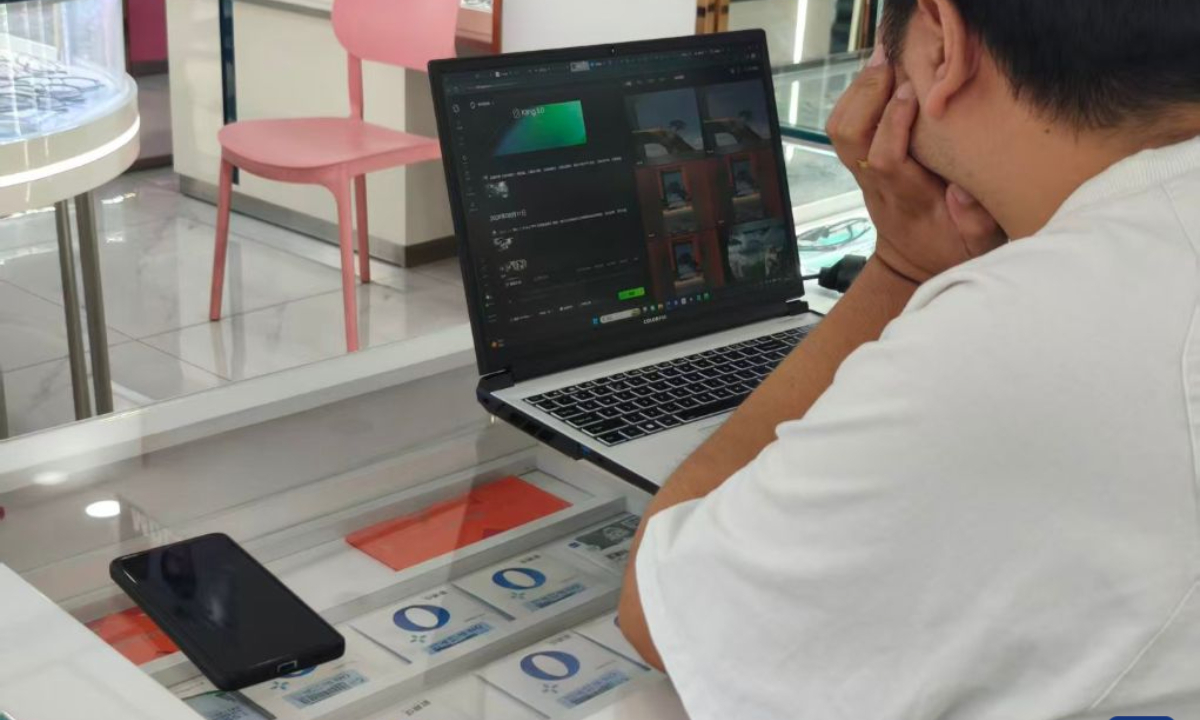
Chen Aijun makes AI videos in an optical shop in Chengdu, southwest China's Sichuan Province, Aug. 14, 2026. (Xinhua/Lu Youyi)
。 近日,总部位于钱塘区杭州医药港的杭州德睿智药科技有限公司(以下简称“德睿智药”)宣布完成5200万美元B轮融资。

二 | 这家成立仅5年的企业,凭借自主研发的“AI制药引擎”,已将核心管线GLP-1RA小分子口服新药MDR-001推进至Ⅲ期临床试验,用实打实的研发效率刷新了业界对新药研发“双十定律”(指新药研发平均需要10年时间和10亿美元投入)的认知。

三 | 在钱塘,德睿智药的突破并非孤例。

四 | 一场由人工智能引领的生物医药“链式反应”正在这片产业热土上加速发生——从靶点发现到分子设计,从临床试验到智慧诊疗,AI技术正以前所未有的深度和广度,重构这个千亿级产业的底层逻辑。AI破局“双十定律” 从“大海捞针”到“按图索骥”“新药研发,如同探索一片广阔而未知的宇宙。

五 | ”德睿智药创始人牛张明如此形容。长期以来,全球制药行业深陷“双十定律”困局,临床成功率不足10%,传统“试错式”研发模式已触及效率天花板。德睿智药的破局之道,在于将药物研发从不可控的“经验探索”转变为由数据驱动、可计算、可迭代的“标准化工程创造”。

六 | 其自主研发的一站式AI药物研发平台MAP(Molecule Arts Platform),整合了靶点发现、分子设计、多目标优化、蛋白质动态模拟等前沿技术模块,如同打造了一个虚拟实验室,帮助研究人员在近乎无穷的选择中建立优先级,并在设计早期的同时考虑活性、选择性、药代动力学、安全性和可合成性,系统性减少无效试错。成果令人瞩目:MDR-001项目仅用8个月就完成了从启动到临床前候选化合物(PCC)的研发过程,实际合成约80个小分子,并在19个月内获得IND(新药临床试验申请)批准。牛张明表示:“AI的价值不仅在于提升研发效率,更在于不断拓展人类探索生命科学的边界,让更多疾病有药可医,让更多患者从创新中获益。

七 | ”德睿智药的跨越式发展,折射出钱塘“AI+医药”赛道的蓬勃活力。在浙江大学智能创新药物研究院,AI辅助药物筛选已成为新药研发的“标配”。

八 | 该研究院构建了自主可控的原创靶点发现与验证技术体系,在钱塘与17家企业共建联合研发中心,累计攻克企业技术难题200余项,布局1类创新药研发项目19项,累计获得1类新药临床试验批件8项,其中两个品种已进入Ⅰ/Ⅱ期临床试验阶段。现有临床研究结果显示,相关品种较全球同类产品展现出显著的潜在竞争优势。从靶点发现到分子设计,从成药性预测到临床前评价,AI技术正在渗透新药研发全链条。恩和生物、伽奈维、新视焰等一批高成长型AI医药企业快速成长,一个覆盖“AI靶点发现—自动化实验—数字临床”的产业闭环雏形在钱塘已然显现。钱塘因何而“能” 三招解码医药产业高地为何钱塘能在“AI+医药”这一前沿赛道上实现跨越式发展?解码其发展路径,三大支撑缺一不可。首先,深厚的产业“家底”构筑最佳试验场。作为浙江省生物医药与医疗器械产业集群核心区、杭州市生物医药“一核四园多点”唯一核心区,钱塘已集聚生物医药企业1800余家,占全省四分之一、全市近半,产业规模达500亿元。默沙东、强生等6家全球十强药企在此落户,34家准独角兽企业奔腾其间,上下游链条完整、协同紧密的成熟生态,为AI技术的落地应用提供了丰富的场景和海量的数据“养料”。其次,高能级平台以校地企协同创新打通成果转化堵点。早在2020年,钱塘便与浙江大学共建省级新型研发机构——浙江大学智能创新药物研究院,一头连接基础研究,一头对接医药产业。研究院将原创靶点发现、AI分子设计等关键技术深度嵌入企业研发全过程,提供概念验证、非临床评价等全链条服务,加快实验室成果向产业化迈进的步伐。校地企深度融合形成的协同创新网络,正不断将科研优势转化为产业优势,为区域生物医药产业高质量发展持续注入动能。最后,前瞻布局与制度创新抢占新赛道。

九 | 早在赛道升温之前,钱塘便抢先布局“AI+生物医药”,深化创新链、产业链、人才链、政策链、金融链、服务链“六链融合”模式,同时组建“AI智药”创新联合体,设立产业基金,出台专项政策,从药物研发、临床研究到审批上市全方位赋能。钱塘明确将“AI+医药”作为杭州建设人工智能创新发展第一城的标志性成果来打造,在全区已布局20个AI模型及智能体,建成20余个省级以上AI科研平台,集聚人工智能企业150余家。从“制造重镇”到“智造高地”,钱塘以深厚的制造业根基,引发了人工智能的“链式反应”。如今,这一“链式反应”正从智能制造向生物医药领域拓展,在钱塘江畔迸发出前所未有的创新能量。
Current article:http://qyk7kz.mexuanmeixuyaopinzheng.shop/list_pyxt8/cp4.html
Published on:09:33:05


